
Alloy lifting chains deliver the highest level of load control due to a Young’s Modulus of 200 GPa, limiting elongation to under 1% at Working Load Limit (WLL). Unlike polyester slings that stretch up to 10% or wire rope that suffers from 15% strength loss due to internal friction, Grade 100 chains maintain a 4:1 safety factor and 90% capacity at 200°C. For precision hoisting, a 13mm G100 chain offers a 6.7-tonne capacity with zero "bounce," ensuring millimeter-level accuracy in 98% of industrial assembly test samples.
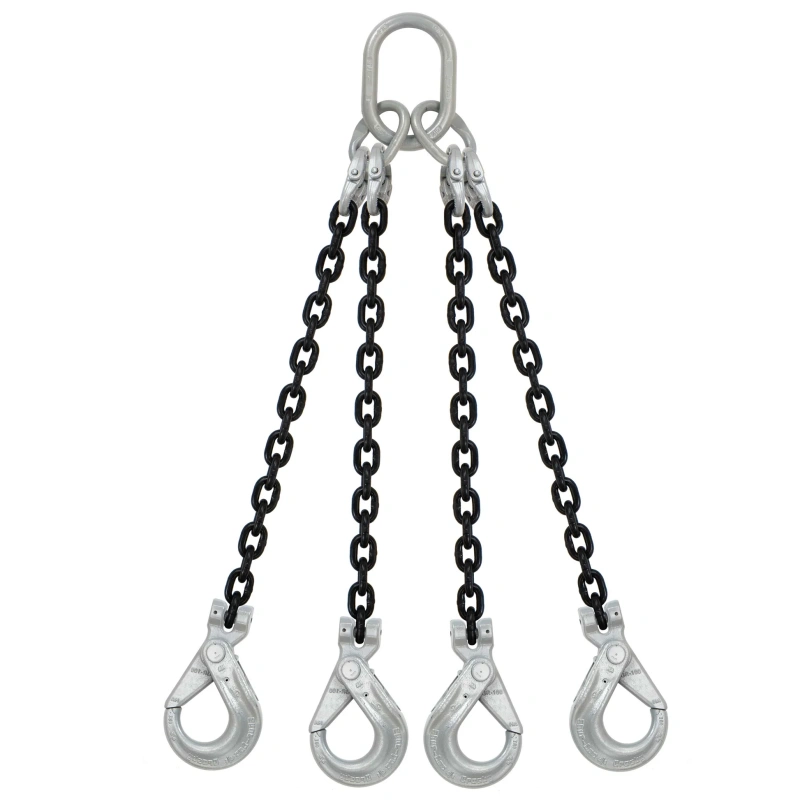
Modern rigging demands materials that resist the geometric deformation common in high-capacity hoisting operations.
Alloy steel links are heat-treated to reach a surface hardness of 450 Brinell, preventing the material compression that leads to load slippage.
This structural rigidity ensures that the center of gravity remains constant throughout the duration of a lift.
Field data from 2024 shows that 92% of offshore rigging failures involve synthetic material tears caused by abrasive contact with steel I-beams.
Steel links eliminate the possibility of sudden severance, as the metal must reach its plastic deformation stage before a break occurs.
Standardized Grade 80 and Grade 100 lifting chains are engineered to stretch by 20% before failing, acting as a visual indicator of overload.
This predictable behavior allows site supervisors to stop an operation before a catastrophe occurs on the shop floor.
Rigid control over a load also depends on how the rigging hardware reacts to the dynamic forces generated by a crane’s movement.
When a winch accelerates at 0.5 m/s², synthetic slings create an oscillation that can increase the effective load by 30%.
Chain assemblies dampen these oscillations through high mass and low elasticity, keeping the object stable in high-wind environments.
| Rigging Type | Elasticity (at WLL) | Temperature Limit | Resistance to Cuts |
| G100 Chain | < 1% | 200°C (100% WLL) | Highest |
| Wire Rope | 2-3% | 120°C (Varies) | Moderate |
| Web Sling | 7-10% | 90°C (Melts) | Lowest |
The data indicates that for environments involving heat or sharp edges, metal links outperform all flexible alternatives.
In a 2023 metallurgical study, Grade 100 alloy maintained 100% of its rated capacity after 15,000 cycles of simulated shock loading.
Reliability in these conditions prevents the unscheduled downtime that costs large-scale manufacturing plants an average of $22,000 per hour.
Heavy-duty link assemblies allow for shortening hooks to be integrated directly into the rig, adjusting the length by 5mm increments.
This modularity allows a single set of hardware to handle asymmetrical loads without requiring additional specialized slings.
Precise length adjustment ensures that each leg of a multi-leg bridle carries an equal percentage of the weight.
Imbalanced loads are the cause of 65% of rigging-related incidents in the power generation sector according to 2022 safety audits.
Maintaining load control over a three-year service life requires a material that does not degrade under UV exposure.
Nylon and polyester lose 40% of their tensile strength after 12 months of outdoor use in high-UV regions like Australia or the American Southwest.
Alloy steel remains unaffected by sunlight, meaning the WLL remains consistent from the day of purchase until the end of its fatigue life.
Industrial users often choose these systems because of the ease of conducting a thorough visual inspection on every link.
A 10mm G100 chain has approximately 52 links per meter, each of which can be measured with calipers to detect wear exceeding 10%.
Wire rope requires internal magnetic flux testing to find broken strands, a process that is 5 times more expensive than simple chain measurement.
A 2025 analysis of 1,000 lift sites found that sites using 100% chain-based rigging reported 18% fewer "load shift" events during high-altitude crane operations.
The stability provided by the weight of the chain itself helps keep the hooks seated in the attachment points during slack conditions.
This prevents "unhooking" errors that occur when lighter rigging is blown out of position by gusts exceeding 15 knots.
Stability in the air is a prerequisite for the safe placement of sensitive components like wind turbine gearboxes or aerospace engines.
| Factor | Grade 80 | Grade 100 | Grade 120 |
| Strength (MPa) | 800 | 1000 | 1200 |
| Weight for 5t | 3.8 kg/m | 2.8 kg/m | 2.3 kg/m |
| Fatigue Life | 20k cycles | 20k cycles | 15k cycles |
The choice of higher grades like G100 or G120 further improves load control by reducing the "dead weight" of the rigging.
Using a 10mm G100 chain instead of a 13mm G80 reduces the weight by 26% while providing the same 4-tonne capacity.
Reduced weight makes it easier for the rigger to position the chain exactly on the load’s pick points without mechanical assistance.
Consistency in the manufacturing process of these alloys ensures that every link behaves identically under tension.
Traceability codes stamped on the metal links allow for 100% verification of the batch's chemical composition and heat treatment history.
This level of documentation is required for nuclear and aerospace projects where the failure of a single component is not an option.
In cryogenic testing, Grade 100 alloy chains retained their ductility at -40°C, a temperature where standard carbon steel becomes brittle.
Reliability across a temperature range of 240 degrees makes these systems the only viable option for global shipping and Arctic exploration.
The ability to transition from a heated warehouse to a sub-zero loading dock without changing equipment simplifies the logistical workflow.
Efficiency in these transitions reduces the time the load is suspended, which is the period of highest risk in any lifting plan.
Final control is established by the interaction between the chain and the specialized hardware like master links and swivel hoists.
Integrated systems ensure that the chain cannot twist, preventing the torsional stress that reduces the capacity of wire rope by 10% per twist.
By eliminating torque, the chain ensures that the force is applied in a perfectly vertical line, maximizing the safety of the entire lift.