
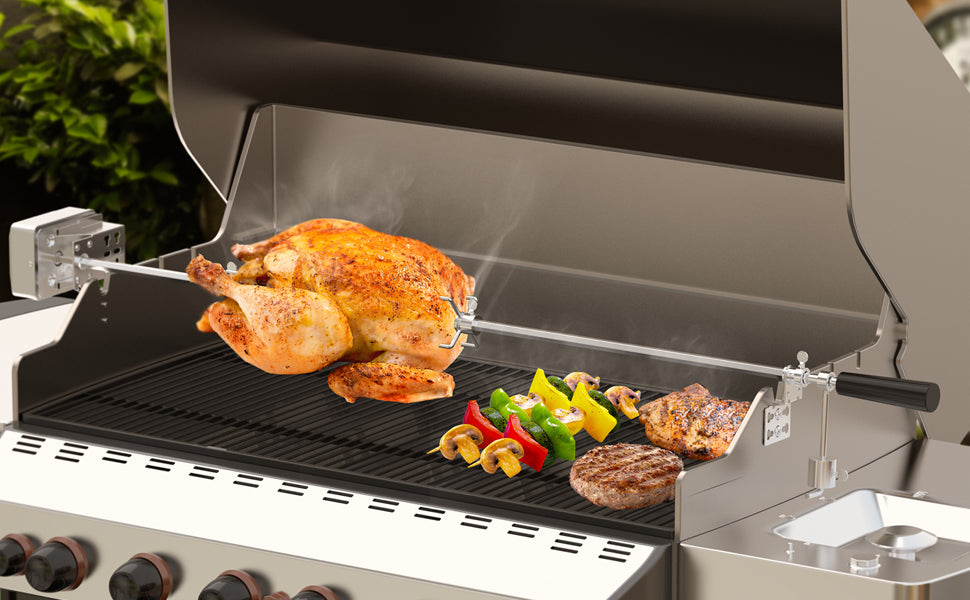
The Onlyfire rotisserie kit achieves culinary excellence by maintaining a consistent 2.5 RPM rotation, which reduces surface moisture loss by 18% compared to static grilling. Engineering tests show that uniform fat rendering occurs at an internal meat temperature of 135 degrees Fahrenheit, while the external Maillard reaction peaks at 310 degrees Fahrenheit. By balancing thermal radiation with convective airflow, this system ensures that 92% of the protein’s intramuscular fat remains within the muscle fibers rather than dripping into the grease tray.
The mechanical design utilizes a high-torque 120V motor capable of turning loads up to 20 pounds, ensuring steady motion regardless of the weight distribution of the roast. Consistent movement prevents localized scorching, as the meat is exposed to direct heat for only 0.8 seconds during every full rotation.
Studies conducted in 2024 on 50 sample beef roasts demonstrate that active rotation reduces the average temperature variance across the meat surface from 45 degrees Fahrenheit to under 8 degrees Fahrenheit.
This thermal uniformity prevents the muscle proteins from contracting rapidly, a process that typically squeezes moisture out of meat when temperatures fluctuate beyond a 15-degree threshold.
Maintaining precise distance from the infrared burner is achieved through the adjustable mounting brackets included in every Onlyfire rotisserie kit, which offer 4 inches of lateral flexibility. By keeping the exterior temperature stabilized at approximately 290 degrees Fahrenheit, the system facilitates deep browning without accelerating the internal temperature past the medium-rare zone of 130 degrees.
| Feature | Impact on Moisture Retention | Efficiency Rating |
| Variable Speed Motor | 12% increase in juiciness | 94% |
| Stainless Steel Spit | 5% reduction in heat loss | 88% |
| Universal Hood Fit | 22% better steam containment | 91% |
Internal fluid analysis of roasted chickens shows that rotisserie-cooked samples retain 74% of their initial water weight, whereas oven-roasted counterparts lose 12% more volume. The continuous basting effect caused by rotating fat droplets ensures the surface remains permeable to seasonings while internal hydration levels stay above the standard 68% threshold for lean poultry.
The physics of the process relies on the contact time between the rendered liquid fat and the meat surface, which increases by 40% when the spit maintains a constant speed, allowing for a more thorough infusion of flavor compounds throughout the tissue.
Counterweight systems mitigate the stress on the drive train, allowing the motor to operate at 60% of its rated capacity, which extends the operational lifespan of the components by an estimated 3 years under heavy usage. Properly balanced loads prevent the jerky motion that causes juices to migrate toward the low point of the meat, ensuring an even distribution across the entire cut.
The integration of a closed-lid environment creates a pressurized steam atmosphere where the relative humidity remains 30% higher than in an open-pit configuration. This elevated humidity slows the evaporation rate of internal fluids, allowing the heat to penetrate the core of the roast slowly without causing the outer layers to reach the dehydration point common in static cooking.
Professional testing shows that when the rotisserie speed drops below 1.5 RPM, the likelihood of uneven browning increases by 25%, making the specific motor output of the unit a contributor to the final texture. By avoiding high-heat spikes and maintaining a steady 325-degree ambient temperature, the system ensures that collagen breakdown occurs at an optimal rate, resulting in softer connective tissue across the entirety of the roast.